


I replaced my 8" sub (again).


Thread Starter
Senior Member
Joined: 02-23-2006
Posts: 629
From: Oklahoma
I replaced my 8" sub (again).
Well I broke down and replaced my 8" sub again. I pulled out the JL Audio 8W0 and put in an Kicker CVR8. I needed a speaker that could handle more power than the JL.

Here is the the box covered in Roadkill.
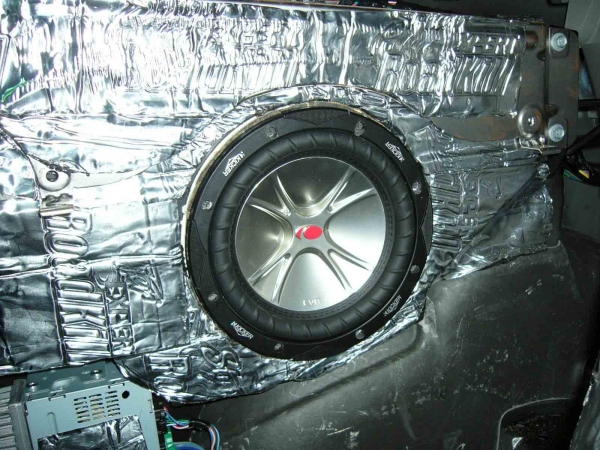
In order to get the CVR8 to seal right I installed a ring/spacer to ensure clearence.
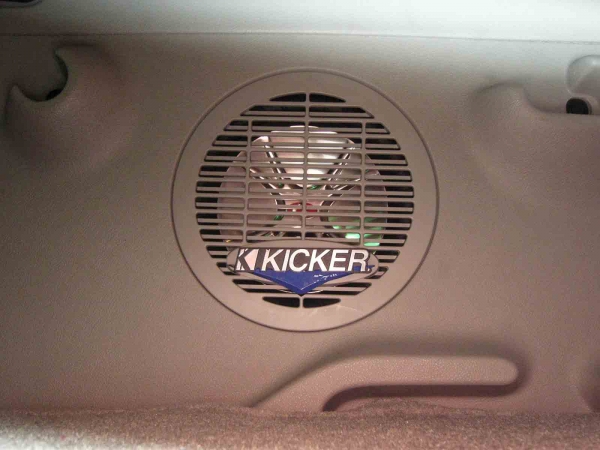
here is the speaker installed with the Kicker badge.
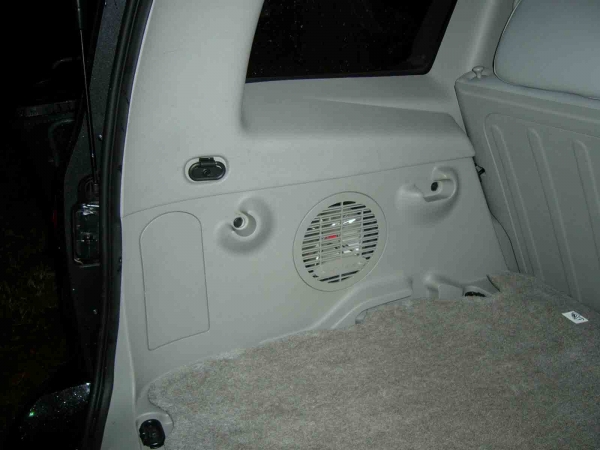
Here is the rear befor the badge. I wired the CVR in parallel, it is a dual voice coil 4ohms each. Thuss making it a 2ohm load. Furter more the bridging module cuts the impedance in 1/2 making a total load of 1 omh. The Orion HCCA 225 I am using is stable down to a 1/2 ohm load. In that configuration I can get 400 watts easy.
Here is the the box covered in Roadkill.
In order to get the CVR8 to seal right I installed a ring/spacer to ensure clearence.
here is the speaker installed with the Kicker badge.
Here is the rear befor the badge. I wired the CVR in parallel, it is a dual voice coil 4ohms each. Thuss making it a 2ohm load. Furter more the bridging module cuts the impedance in 1/2 making a total load of 1 omh. The Orion HCCA 225 I am using is stable down to a 1/2 ohm load. In that configuration I can get 400 watts easy.




Banned
Joined: 10-14-2005
Posts: 9,121
From: Rochester,N.Y.
I am going to simplify things and not get into formulas or anything. Basically it is a measurement of electical resistance on the line. A more technical definition would be it is a law that definines the relationship between power, voltage, current, and resistance. Basically in a nut shell the less resistance between the amp and your speakers the more efficiently they will opperate.

Senior Member
Joined: 02-06-2006
Posts: 297
From: Raleigh, NC
I=v*r
*** Strange... I posted the formula before CH's reply, but it showed up 7 minutes after??? ***
Another note: Resistance in series adds up, while in parallel it divides. Example: Two 4 ohm speakers wired in series will present an 8 ohm load to the amp. Two 4 ohm speakers wired in parallel will present a 2 ohm load to the amp.
*** Strange... I posted the formula before CH's reply, but it showed up 7 minutes after??? ***
Another note: Resistance in series adds up, while in parallel it divides. Example: Two 4 ohm speakers wired in series will present an 8 ohm load to the amp. Two 4 ohm speakers wired in parallel will present a 2 ohm load to the amp.