


Test Drove my first SS, my observations

Senior Member
Joined: 04-26-2009
Posts: 669
From: City of Champions
Yes, you are correct 2005HHRauto.( I believe we had this conversation before)
I was just trying to tell the OP that basically the boost numbers he saw could be lower because of the GM programming for the autos. I didn't want to get to technical with him and overload him with precise techno numbers.
All in all, I think the SS he test drove has some mechanical issues from his description.
I was just trying to tell the OP that basically the boost numbers he saw could be lower because of the GM programming for the autos. I didn't want to get to technical with him and overload him with precise techno numbers.
All in all, I think the SS he test drove has some mechanical issues from his description.

A simple, 'tune', will wake the 'beast' up...

True Dr jekyll and Mr hyde personalities, with one apparently weak, and the other downright evil...

Friends, don't let friends, drive an HHR SS automatic, without a 'tune'...

Just a simple $200 'tune' will put a stock HHR SS automatic, into the 13s at the track,
& make a perfect, fun, year round Daily Driver...


Thread Starter
Joined: 02-18-2015
Posts: 8
From: Bluffton SC
I truly appreciate all of the info I have been given so far, and its good to know about the tune.. I have seen that talked about in other threads. How does that work, is it a simple OBD2 plug in that does the job?? Or do I need to take it to a shop that does that kind of work??
Sounds like my gut feeling on the HHR I drove was right about it not being 100%.
ONE MORE question, with the car at idle and the hood up I could hear a repetitive click, like a solenoid click.. it was very rhythmic, click....click....click....click... Is that normal on these??
Thanks
JOSH
Sounds like my gut feeling on the HHR I drove was right about it not being 100%.
ONE MORE question, with the car at idle and the hood up I could hear a repetitive click, like a solenoid click.. it was very rhythmic, click....click....click....click... Is that normal on these??
Thanks
JOSH

Banned
Joined: 10-02-2010
Posts: 5,933
From: Port Huron, MI
I truly appreciate all of the info I have been given so far, and its good to know about the tune.. I have seen that talked about in other threads. How does that work, is it a simple OBD2 plug in that does the job?? Or do I need to take it to a shop that does that kind of work??
Sounds like my gut feeling on the HHR I drove was right about it not being 100%.
ONE MORE question, with the car at idle and the hood up I could hear a repetitive click, like a solenoid click.. it was very rhythmic, click....click....click....click... Is that normal on these??
Thanks
JOSH
Sounds like my gut feeling on the HHR I drove was right about it not being 100%.
ONE MORE question, with the car at idle and the hood up I could hear a repetitive click, like a solenoid click.. it was very rhythmic, click....click....click....click... Is that normal on these??
Thanks
JOSH
Document ID# 2049170
--------------------------------------------------------------------------------
Subject: Clicking/Ticking Sound/Noise Heard During Cold Start - Sound/Noise Decreases But Continues As Engine Warms (Normal Operation of High Pressure Fuel Pump and Injectors) #06-06-93-001C - (01/16/2008)
Models: 2008 Chevrolet HHR SS
2007-2008 Pontiac Solstice
2007-2008 Saturn Sky
2007-2008 Opel GT
2007-2008 Daewoo G2X
with 2.0L Turbo Engine (VIN X - RPO LNF)
--------------------------------------------------------------------------------
This bulletin is being revised to add the 2008 Chevrolet HHR SS. Please discard Corporate Bulletin Number 06-06-93-001B (Section 06-Engine).
--------------------------------------------------------------------------------
Do This
Don't Do This
Inform the customer that this is normal operation of the high pressure fuel pump and injectors.
DO NOT replace the high pressure fuel pump and or injectors.
The 2.0L turbo engine (VIN X - RPO LNF) uses a direct injection fuel system that operates at very high fuel pressures. A direct injection fuel system produces a rapid, clicking and ticking sound that can be heard from the engine compartment. The sound is more evident when outside around the vehicle or when the hood is open. The sound is more noticeable during idle, and is more frequent during a cold start but lessens once the engine is warm. The rapid ticking noise on cold start up is the fuel pump (located on the rear of the cylinder head) building up high fuel pressure. When the engine warm-up is completed, the high pressure fuel pump will continue to tick at a lower rate of approximately one tick per second during idle. The clicking sound is the fuel injectors pulsing on and off under higher fuel pressures. These sounds are the results of a normal direct injection fuel system operating properly.
DO NOT attempt to repair or replace any parts for this kind of clicking or ticking concern. The clicking or ticking sound is not indicative of any concerns with the engine or the vehicle. You may wish to give the customer a copy of this bulletin.
GM bulletins are intended for use by professional technicians, NOT a "do-it-yourselfer". They are written to inform these technicians of conditions that may occur on some vehicles, or to provide information that could assist in the proper service of a vehicle. Properly trained technicians have the equipment, tools, safety instructions, and know-how to do a job properly and safely. If a condition is described, DO NOT assume that the bulletin applies to your vehicle, or that your vehicle will have that condition. See your GM dealer for information on whether your vehicle may benefit from the information.
WE SUPPORT VOLUNTARY TECHNICIAN CERTIFICATION
© Copyright General Motors Corporation. All Rights Reserved.
--------------------------------------------------------------------------------
Document ID# 2049170
___
--------------------------------------------------------------------------------
Subject: Clicking/Ticking Sound/Noise Heard During Cold Start - Sound/Noise Decreases But Continues As Engine Warms (Normal Operation of High Pressure Fuel Pump and Injectors) #06-06-93-001C - (01/16/2008)
Models: 2008 Chevrolet HHR SS
2007-2008 Pontiac Solstice
2007-2008 Saturn Sky
2007-2008 Opel GT
2007-2008 Daewoo G2X
with 2.0L Turbo Engine (VIN X - RPO LNF)
--------------------------------------------------------------------------------
This bulletin is being revised to add the 2008 Chevrolet HHR SS. Please discard Corporate Bulletin Number 06-06-93-001B (Section 06-Engine).
--------------------------------------------------------------------------------
Do This
Don't Do This
Inform the customer that this is normal operation of the high pressure fuel pump and injectors.
DO NOT replace the high pressure fuel pump and or injectors.
The 2.0L turbo engine (VIN X - RPO LNF) uses a direct injection fuel system that operates at very high fuel pressures. A direct injection fuel system produces a rapid, clicking and ticking sound that can be heard from the engine compartment. The sound is more evident when outside around the vehicle or when the hood is open. The sound is more noticeable during idle, and is more frequent during a cold start but lessens once the engine is warm. The rapid ticking noise on cold start up is the fuel pump (located on the rear of the cylinder head) building up high fuel pressure. When the engine warm-up is completed, the high pressure fuel pump will continue to tick at a lower rate of approximately one tick per second during idle. The clicking sound is the fuel injectors pulsing on and off under higher fuel pressures. These sounds are the results of a normal direct injection fuel system operating properly.
DO NOT attempt to repair or replace any parts for this kind of clicking or ticking concern. The clicking or ticking sound is not indicative of any concerns with the engine or the vehicle. You may wish to give the customer a copy of this bulletin.
GM bulletins are intended for use by professional technicians, NOT a "do-it-yourselfer". They are written to inform these technicians of conditions that may occur on some vehicles, or to provide information that could assist in the proper service of a vehicle. Properly trained technicians have the equipment, tools, safety instructions, and know-how to do a job properly and safely. If a condition is described, DO NOT assume that the bulletin applies to your vehicle, or that your vehicle will have that condition. See your GM dealer for information on whether your vehicle may benefit from the information.
WE SUPPORT VOLUNTARY TECHNICIAN CERTIFICATION
© Copyright General Motors Corporation. All Rights Reserved.
--------------------------------------------------------------------------------
Document ID# 2049170
___
Thread Starter
Joined: 02-18-2015
Posts: 8
From: Bluffton SC
Thanks for that, but it was not injector tick.. it was much different.. Like click 1..2... click..1..2...click...1..2.. Again like a solenoid.. not sure what it was but it seemed to be coming from the brass colored (at least I think it was brass) disk at the top of the motor..
Senior Member
Joined: 04-26-2009
Posts: 669
From: City of Champions
Thanks for that, but it was not injector tick.. it was much different.. Like click 1..2... click..1..2...click...1..2.. Again like a solenoid.. not sure what it was but it seemed to be coming from the brass colored (at least I think it was brass) disk at the top of the motor..


Senior Member
Joined: 11-05-2011
Posts: 417
From: simi valley CA.
it is the high out put fuel pump you heard go click click for sure!
And their write about the tune, mine is an automatic which was dyo tuned with HP software and has 25 psi from the turbo so 5 or ten that car was definatly sick
My auto with the tune and mods will leave a stock ss stick still 3/4 down the 1/4 mile when I have already hit the finish line so like they said friends don't let friends drive an ss auto with out it being tuned first. Also there are a few really nice ss's for sale on the forum that are stick and very clean, remember most of the time you get what you pay for..and shipping a car is not that expensive.
And their write about the tune, mine is an automatic which was dyo tuned with HP software and has 25 psi from the turbo so 5 or ten that car was definatly sick
My auto with the tune and mods will leave a stock ss stick still 3/4 down the 1/4 mile when I have already hit the finish line so like they said friends don't let friends drive an ss auto with out it being tuned first. Also there are a few really nice ss's for sale on the forum that are stick and very clean, remember most of the time you get what you pay for..and shipping a car is not that expensive.

Senior Member
Joined: 10-06-2011
Posts: 1,150
From: Mesa, AZ
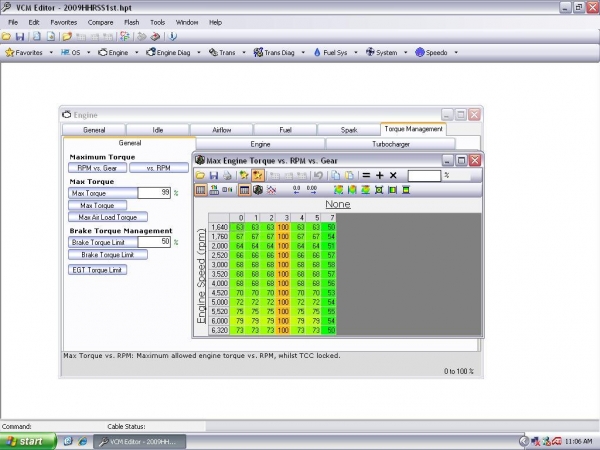
Boost/torque, is limited in all gears, but 3rd, with an automatic, as shown in the chart below....
You can see that 100% of boost/torque/power, is available in one gear only...
Ony 63%-79% of boost/torque/power, is available, in all gears, but one...
There is NO other vehicle, that GM has has done this too, in history, but this is the only way, that GM was allowed, by engineering, to put an automatic, in our HHR SS 'buggys'.
That's why a 'tune', any 'tune', is the single most best improvement, that you can do to an automatic HHR SS 'buggy'...
Our 4T45E automatic, can handle more power, better than GM thought, that it could...
I've proved, after 6 seasons at the track, with 60' times in the 1.6s, & ETs in the 12.3s, that it can get the job done..
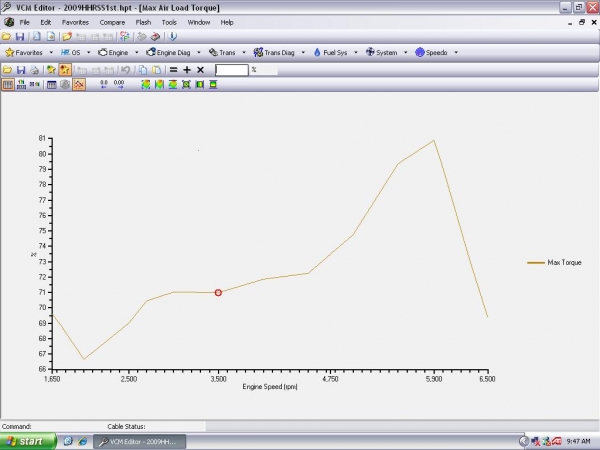
Here's another stock graph, of the pitiful , 'power-curve', that shows even more loss of boost/torque/power, on top of the reduction, in the 'gear' chart. Notice how the power, takes a 'dive', after 5,900 RPM
Combine the two, & your stock HHR SS automatic, is a slug…
You can see that 100% of boost/torque/power, is available in one gear only...
Ony 63%-79% of boost/torque/power, is available, in all gears, but one...
There is NO other vehicle, that GM has has done this too, in history, but this is the only way, that GM was allowed, by engineering, to put an automatic, in our HHR SS 'buggys'.
That's why a 'tune', any 'tune', is the single most best improvement, that you can do to an automatic HHR SS 'buggy'...
Our 4T45E automatic, can handle more power, better than GM thought, that it could...
I've proved, after 6 seasons at the track, with 60' times in the 1.6s, & ETs in the 12.3s, that it can get the job done..
Here's another stock graph, of the pitiful , 'power-curve', that shows even more loss of boost/torque/power, on top of the reduction, in the 'gear' chart. Notice how the power, takes a 'dive', after 5,900 RPM
Combine the two, & your stock HHR SS automatic, is a slug…