


2008 HHR 2LT needs new Front Struts... advice please


Moderator
Joined: 01-23-2009
Posts: 26,484
From: Fredericksburg,VA
I meant to imply that the mounts include a bearing, and some parts books call it a strut bearing. They are pricey, for a couple of pieces of plastic with grease in between. If I remember correctly around $30 each.
Moderator
Joined: 01-23-2009
Posts: 26,484
From: Fredericksburg,VA
I was only tryint to let him know why he see's oil on the shock.... If you wanna get technical...The development of gas charged shock absorbers was a major advance in ride control technology. This advance solved many ride control problems which occurred due to an increasing number of vehicles using uni-body construction, shorter wheelbases and increased use of higher tire pressures.
The design of twin tube gas charged shock absorbers solves many of today's ride control problems by adding a low pressure charge of nitrogen gas in the reserve tube. The pressure of the nitrogen in the reserve tube varies from 100 to 150 psi, depending on the amount of fluid in the reserve tube. The gas serves several important functions to improve the ride control characteristics of a shock.
The prime function of gas charging is to minimize aeration of the hydraulic fluid. The pressure of the nitrogen gas compresses air bubbles in the hydraulic fluid. This prevents the oil and air from mixing and creating foam. Foam affects performance because it can be compressed - fluid can not. With aeration reduced, the shock is able to react faster and more predictably, allowing for quicker response time and helping keep the tire firmly planted on the road surface.
An additional benefit of gas charging is that it creates a mild boost in spring rate to the vehicle. This does not mean that a gas charged shock would raise the vehicle up to correct ride height if the springs were sagging. It does help reduce body roll, sway, brake dive, and acceleration squat.
This mild boost in spring rate is also caused by the difference in the surface area above and below the piston. With greater surface area below the piston than above, more pressurized fluid is in contact with this surface. This is why a gas charged shock absorber will extend on its own.
The final important function of the gas charge is to allow engineers greater flexibility in valving design. In the past such factors as damping and aeration forced compromises in design.
If you wanna get technical...The development of gas charged shock absorbers was a major advance in ride control technology. This advance solved many ride control problems which occurred due to an increasing number of vehicles using uni-body construction, shorter wheelbases and increased use of higher tire pressures.The design of twin tube gas charged shock absorbers solves many of today's ride control problems by adding a low pressure charge of nitrogen gas in the reserve tube. The pressure of the nitrogen in the reserve tube varies from 100 to 150 psi, depending on the amount of fluid in the reserve tube. The gas serves several important functions to improve the ride control characteristics of a shock.
The prime function of gas charging is to minimize aeration of the hydraulic fluid. The pressure of the nitrogen gas compresses air bubbles in the hydraulic fluid. This prevents the oil and air from mixing and creating foam. Foam affects performance because it can be compressed - fluid can not. With aeration reduced, the shock is able to react faster and more predictably, allowing for quicker response time and helping keep the tire firmly planted on the road surface.
An additional benefit of gas charging is that it creates a mild boost in spring rate to the vehicle. This does not mean that a gas charged shock would raise the vehicle up to correct ride height if the springs were sagging. It does help reduce body roll, sway, brake dive, and acceleration squat.
This mild boost in spring rate is also caused by the difference in the surface area above and below the piston. With greater surface area below the piston than above, more pressurized fluid is in contact with this surface. This is why a gas charged shock absorber will extend on its own.
The final important function of the gas charge is to allow engineers greater flexibility in valving design. In the past such factors as damping and aeration forced compromises in design.

Senior Member
Joined: 01-13-2008
Posts: 4,708
From: Washington State, where it rains
Technical is nice..allows people who don't know..to know...but also let them know correctly.Its amazing how little a lot of car owners know about the parts they are about to replace...if they knew more it would influence what parts they actually use for replacement instead of just the price of that part...

Senior Member
Joined: 07-08-2009
Posts: 265
From: Dublin.CA
What Woody says is correct and I'm glad interest is finally developing in shocks as everyone seems all excited about springs. Just remember "springs" are dumb all they know is when weight is applied they compress and when weight is removed they expand. It's the shocks that give springs "intelligence" they tell the springs how fast to compress and how fast to rebound. In our case springs establish "ride height" after that the suspension is controlled by sway bars and shocks. Springs also control load rating for obvious reasons.Quite simply shocks are the key to "handling" and the definition of that is up to the end user.

Thread Starter
Member
Joined: 08-18-2009
Posts: 37
From: The Dirty 330
I ended up replacing the Struts with a set of KYBs and the ride smoothed out and quieted down a little. I took it back to the shop and they informed me that the sway bar end links were bad. I replaced those with a set of Moogs only to find the noise still there albeit very slight. I took apart the passenger side again and re-tightened every bolt and nut attached to the damn strut and (for now) the noise is gone.
Now to tackle the squeak in the rear end. I was told it was bushing but also if I can stand the noise it wouldn't hurt anything. Rear sway bar bushings maybe???
Now to tackle the squeak in the rear end. I was told it was bushing but also if I can stand the noise it wouldn't hurt anything. Rear sway bar bushings maybe???

 nortonneon

Joined: 06-05-2015
Posts: 2
From: illinois
HeR strut install warnings
QUOTE=OhioPest;457710]I'll buy aftermarket, do it myself and save a couple hundred then. It doesn't look too incredibly difficult to me... Without having it in front of me it would seem from memory to be: 3 bolts on top, 2 on the bottom, a wiring harness and a compressed spring.[/QUOTE]
Let. Me say the video is good, the bolts easy access and process simple s o yes it s a good way to save but be sure you have the tools, extra time, and equipment or extra vehicle if needed. I spent forever getting my top bolts out for silly reasons borrowing a couple of socket heads and actually h a going to return to shop that w a s overzealous over tightened my lugs nuts on new tire :..mine top were actually 1/2 and then got to the bottom bolts to discover wouldn't t budge. Had to get daughter so had to put tire and top bolts on and wheel, leave, and pick up daughter borrowing breaker bar en route.. Next day back at and got up to the sway bar bolt which broke free but
Let. Me say the video is good, the bolts easy access and process simple s o yes it s a good way to save but be sure you have the tools, extra time, and equipment or extra vehicle if needed. I spent forever getting my top bolts out for silly reasons borrowing a couple of socket heads and actually h a going to return to shop that w a s overzealous over tightened my lugs nuts on new tire :..mine top were actually 1/2 and then got to the bottom bolts to discover wouldn't t budge. Had to get daughter so had to put tire and top bolts on and wheel, leave, and pick up daughter borrowing breaker bar en route.. Next day back at and got up to the sway bar bolt which broke free but
Moderator
Joined: 01-23-2009
Posts: 26,484
From: Fredericksburg,VA
QUOTE=OhioPest;457710]I'll buy aftermarket, do it myself and save a couple hundred then. It doesn't look too incredibly difficult to me... Without having it in front of me it would seem from memory to be: 3 bolts on top, 2 on the bottom, a wiring harness and a compressed spring.
H'mmm.
Top 3 nuts are metric (14 MM IIRC). In fact every nut & bolt I've found on my 2 HHRs are.
The bottom 2 "bolts" are captured via force fit splines. Remove the nuts then drift the bolts out (hammer & screwdriver).
No need to compress springs; IF you purchase "complete" struts.
Most people set aside a time to pick the daughter up, so I don't see the relevance.
Last edited by donbrew; Jun 5, 2015 at 11:33 PM.

Platinum Member
Joined: 12-06-2009
Posts: 11,719
From: Alabama
As donbrew stated, you have to take the nuts off the lower 2 strut bolts, then tap the bolts out.
Those bolts have splines on the shoulder of the bolt and are not meant to turn when installed in place.
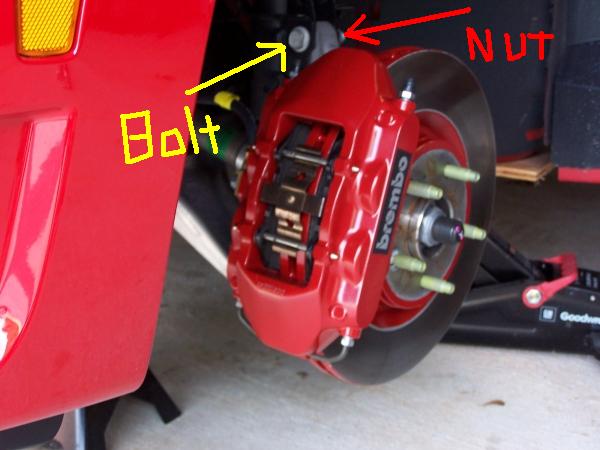
Those bolts have splines on the shoulder of the bolt and are not meant to turn when installed in place.

Thread
Thread Starter
Forum
Replies
Last Post
fuzionimports
Brakes | Suspension | Shocks | Struts
35
Jun 29, 2016 05:00 PM