


Anti-Sway Bars


Senior Member
Joined: 10-02-2005
Posts: 1,245
From: VA

Originally Posted by cj krause
...or just use the jack.
 That suggestion is both stupid and dangerous!!
Never go under a car without it safely being supported! Never with a hydraulic jack supporting even part of the car!!
Use either ramps or fully supported by jackstands.
Remember, Darwin Awards are only given to those that survive!


Member
Joined: 06-24-2006
Posts: 80
From: US
Originally Posted by JoeR
Remember, Darwin Awards are only given to those that survive!
Member
Joined: 06-24-2006
Posts: 80
From: US
www.darwinawards.com
We salute the improvement of the human genome
by honoring those who remove themselves from it.
Of necessity, this honor is generally bestowed posthumously.
We salute the improvement of the human genome
by honoring those who remove themselves from it.
Of necessity, this honor is generally bestowed posthumously.

Senior Member
Joined: 01-01-2008
Posts: 991
From: Windsor, Ca
ok...so today I was under my car...it was on a drive-on lift, so no awards, or even nominations are necessary...but thanks.
anyway...I noticed something odd...or lack of odd...or just plain lack of..
there is no real sway bar on the back of a 2LT. there is what they call a "torsional rigidity" bar that travels across the "dead axle" or 'carrier support" frame that is FORWARD of the rear spidles.
this is no sway bar. This is a piece of structural regitity to promote equal traction, stiffen the rear suspension by means of providing side-to-side strength.
But a sway bar, it is not. a sawy bar, or "anti roll" bar is mounted to the "travel" point of a suspension component to equalize the suspension movement from side to side during a change in load caused by inertia.
when you turn left, the load is forced to the right, thus putting more load on the right side suspension, causing it to compress. At the same time, it un-loads the left side suspension, creating a "light spot" on the vehicle's chassis, and can cause handling problems, overload of one side of the car, and unequal amounts of traction.
a sway bar, or "anti-roll" bar attaches to both travel locations of the rear suspension, so that when one side compresses due to load, it pulls the other side with it so that the inertia doesnt have such a strong affect on load equations. In other words, if you compress the right rear suspension by turning left, a anti-roll bar will also compress the left rear suspension to create a level driving plain, to promote equal traction.
since the factory 'sway bar' is mounted in a fixed position on a non-moving part of the rear suspension, it is NOT a sway bar, or anti-roll bar. it is a structural rigidity bar, and nothing more.
there is an old rule of thumb that pertains to rear sway bar thickness vs front sway bar thickness. it is said that the rear bar should never be thicker than the front. This is not always the case. many cars with true independent rear suspension can get away with adding a thicker rear bar than the front bar's diameter, and not end up with a 'tail wagging the dog" feeling...or overtseer.
the HHR's rear suspension design is explained by GM as:
" TORSION BEAM REAR SUSPENSION SEMI-INDEPENDENT WITH STABILIZER BAR AND COIL SPRINGS"
so...unless my car is missing its rear sway bar, in which I could not even see where it would mount, I dont know what to tell you folks as to what to buy.
does anyone have a picture of their rear swaybar installed?
anyway...I noticed something odd...or lack of odd...or just plain lack of..
there is no real sway bar on the back of a 2LT. there is what they call a "torsional rigidity" bar that travels across the "dead axle" or 'carrier support" frame that is FORWARD of the rear spidles.
this is no sway bar. This is a piece of structural regitity to promote equal traction, stiffen the rear suspension by means of providing side-to-side strength.
But a sway bar, it is not. a sawy bar, or "anti roll" bar is mounted to the "travel" point of a suspension component to equalize the suspension movement from side to side during a change in load caused by inertia.
when you turn left, the load is forced to the right, thus putting more load on the right side suspension, causing it to compress. At the same time, it un-loads the left side suspension, creating a "light spot" on the vehicle's chassis, and can cause handling problems, overload of one side of the car, and unequal amounts of traction.
a sway bar, or "anti-roll" bar attaches to both travel locations of the rear suspension, so that when one side compresses due to load, it pulls the other side with it so that the inertia doesnt have such a strong affect on load equations. In other words, if you compress the right rear suspension by turning left, a anti-roll bar will also compress the left rear suspension to create a level driving plain, to promote equal traction.
since the factory 'sway bar' is mounted in a fixed position on a non-moving part of the rear suspension, it is NOT a sway bar, or anti-roll bar. it is a structural rigidity bar, and nothing more.
there is an old rule of thumb that pertains to rear sway bar thickness vs front sway bar thickness. it is said that the rear bar should never be thicker than the front. This is not always the case. many cars with true independent rear suspension can get away with adding a thicker rear bar than the front bar's diameter, and not end up with a 'tail wagging the dog" feeling...or overtseer.
the HHR's rear suspension design is explained by GM as:
" TORSION BEAM REAR SUSPENSION SEMI-INDEPENDENT WITH STABILIZER BAR AND COIL SPRINGS"
so...unless my car is missing its rear sway bar, in which I could not even see where it would mount, I dont know what to tell you folks as to what to buy.
does anyone have a picture of their rear swaybar installed?

Senior Member
Joined: 12-18-2005
Posts: 1,791
From: Middle Village, NY
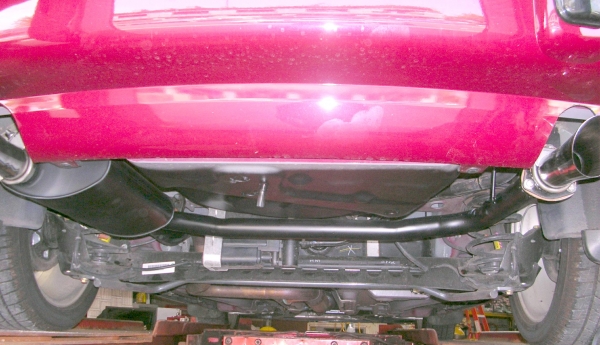
It is not a great picture, but you can see the gray sway bar running up under the rear axle. It mounts very easily in about 10 minutes. There is a plate for each side that has 2 nuts welded to it. You slip it inside the crossmember and hold it in place with a tab that sticks out. It aligns with 2 holes already there. Then, you bolt the sway bar through the holes and into the plate with the nuts. I didn't even need to jack up the car.
It really does improve the handling quite a bit!
Senior Member
Joined: 01-01-2008
Posts: 991
From: Windsor, Ca
so...it mounts to the rear of the trailing arms, and another two mouting points at the torsion axle bar cavity?
I like the dual exhaust...any other shots of that from behind?
I also see some black pieces on the bumper nerfs...
EDIT:
never mind...found it!
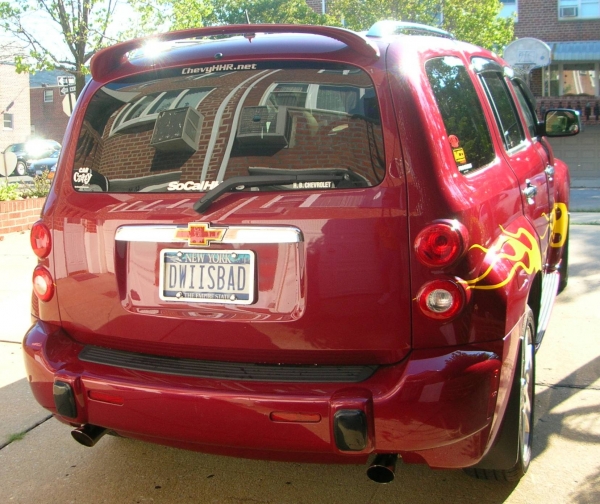
I like the dual exhaust...any other shots of that from behind?
I also see some black pieces on the bumper nerfs...
EDIT:
never mind...found it!
Last edited by Smoke Wagon; Jan 13, 2008 at 10:38 PM. Reason: found what I asked about
Senior Member
Joined: 12-18-2005
Posts: 1,791
From: Middle Village, NY
No. I know most sway bars mount to the control arms and then to the chassis with rubber grommets. For the HHR, it basically connects the 2 wheels. It really does work, though.
My exhaust is not your typical dual system. The passanger side bypasses the muffler, and there is a collector right before the exhaust tip. By placing a solid plate between the 2, the dual is just for show and everything goes through the muffler. Removing the plate opens the exhaust, and a plate with holes in it is a balance of the two.
My exhaust is not your typical dual system. The passanger side bypasses the muffler, and there is a collector right before the exhaust tip. By placing a solid plate between the 2, the dual is just for show and everything goes through the muffler. Removing the plate opens the exhaust, and a plate with holes in it is a balance of the two.

Senior Member
Joined: 11-11-2007
Posts: 364
From: Sheboygan WI
http://www.darwinawards.com/rules/rules1.html
Senior Member
Joined: 11-11-2007
Posts: 364
From: Sheboygan WI
there is no real sway bar on the back of a 2LT. there is what they call a "torsional rigidity" bar that travels across the "dead axle" or 'carrier support" frame that is FORWARD of the rear spidles.
this is no sway bar. This is a piece of structural regitity to promote equal traction, stiffen the rear suspension by means of providing side-to-side strength.
this is no sway bar. This is a piece of structural regitity to promote equal traction, stiffen the rear suspension by means of providing side-to-side strength.