


LDK build


Thread Starter
Senior Member
Joined: 09-02-2010
Posts: 383
From: Philadelphia, PA
Have you triple-verified that the check valves are flowing towards their respective vacuum sources? A backward check valve will create excessive pressure buildup in the crankcase.
If they are for sure installed correctly, I would run a few tests: try bypassing the intake manifold(port 3) check valve(it's unnecessary at idle). If you still have whine, I would try bypassing the catch can.
If they are for sure installed correctly, I would run a few tests: try bypassing the intake manifold(port 3) check valve(it's unnecessary at idle). If you still have whine, I would try bypassing the catch can.
We will have to give that a shot - remove the check valve on port 3, and see what happens.
Thread Starter
Senior Member
Joined: 09-02-2010
Posts: 383
From: Philadelphia, PA
So It's been about a month - with the recent house purchase and engagement, I had to put this project on hold.
I emailed ZZP about this issue, and they're confirming what everyone else said. The opel injectors require a tune, and that's causing the p2178 running rich code. They also mentioned this could be why I'm getting excess crankcase pressure - because the computer is reading the system is too rich, and there's more fuel than air. Tuning the car will adjust everything properly.
So I'll need to continue to save for HPT. Will all the upgrades I'll either get someone to write a tune for all the upgrades, or I'll have to search the HPT forums and see if there's tunes for each upgrade I can install myself.
I emailed ZZP about this issue, and they're confirming what everyone else said. The opel injectors require a tune, and that's causing the p2178 running rich code. They also mentioned this could be why I'm getting excess crankcase pressure - because the computer is reading the system is too rich, and there's more fuel than air. Tuning the car will adjust everything properly.
So I'll need to continue to save for HPT. Will all the upgrades I'll either get someone to write a tune for all the upgrades, or I'll have to search the HPT forums and see if there's tunes for each upgrade I can install myself.
Thread Starter
Senior Member
Joined: 09-02-2010
Posts: 383
From: Philadelphia, PA
After a summer break due to work, an engagement, and a new house, my (now) fiance just told me to finish this build...she demanded it!
So HPtuners just arrived, 3 bar map sensors as well, and a forge atmospheric diverter valve is on it's way.
Thinking over the summer and re-reading this, I need to tune for the opel injectors - which are causing the engine running rich code. Since it's running rich, this could also be building the excess crankcase pressure. If my thought process is correct, then the tune for Opel injectors should solve the p2178 code, and hopefully solve the crankcase whine.
Does anyone have the tuning specs for the opel injectors?
So HPtuners just arrived, 3 bar map sensors as well, and a forge atmospheric diverter valve is on it's way.
Thinking over the summer and re-reading this, I need to tune for the opel injectors - which are causing the engine running rich code. Since it's running rich, this could also be building the excess crankcase pressure. If my thought process is correct, then the tune for Opel injectors should solve the p2178 code, and hopefully solve the crankcase whine.
Does anyone have the tuning specs for the opel injectors?

Senior Member
Joined: 05-29-2015
Posts: 542
From: Cleveland, OH
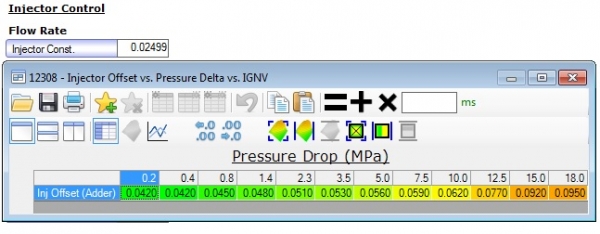
Congrats! She said yes! Here you are sir. I know you PMed me a while back. I've been terribly busy myself. Here you are, currently in running e47 constant though. Which was posted over in the e85 thread (I think)
Thread Starter
Senior Member
Joined: 09-02-2010
Posts: 383
From: Philadelphia, PA
Thank you! HPTuners site has been my bible recently. I've been bookmarking every thread I find that relates to all the upgrades I've done so far. I got a little confused since a few HPT members were stating some things that contradicted one another (some said multiply, others said divide).
Good to see this table confirms to make the values smaller. Thank you!
Thread Starter
Senior Member
Joined: 09-02-2010
Posts: 383
From: Philadelphia, PA
Thanks to Dbeluscak for the numbers for the Opel injectors. Plugged them in with HPT, and sounds like the car is boosting...can't test it yet due to a grounding issue with the starter that ROASTED my stainless front brake lines. That was fixed, but the damage to the brake lines is casing the pedal to hit the floor and brake fluid to shoot out any time the brakes are applied.
On another note - I'm still getting excess crankcase pressure, and like A LOT of you mentioned, I think it's safe to say it's because of the way I have port 2 and the manifold teed together to go into the catch can.

I pulled the hose coming from the PCV in the manifold, and could feel a slight vacuum coming from the barb at the base of the manifold while the car is idling. If I remember what we all have discussed, the LNF/LDK engine is getting vacuum from port 2 during idle, and under boost conditions it switches to vacuum from the PCV, correct? or is it the reverse?
Either way, I think It's time for a 2 can setup - the current can i'll leave in place between port #2 and the turbo, and I'll fabricate a small catch can for the manifold just to experiment. If that eliminates the crankcase pressure, then I can look into getting a larger can for the manifold.
WAIT A MINUTE!!!!
Reading Dan's Installing an Oil Catch can thread, I re-read his response from ZZP regarding blocking port #1 and only using port #2.
"When the pcv system is stock, air enters the crankcase from the line in the middle of the head (the one that gets plugged.) Then it is drawn into the motor through the pcv valve in the intake manifold. This is only during vacuum situations. When you boost, the pcv valve closes and the crankcase ventilates out both hoses into the intake tube and turbo. When we tried to run the stock hose only, it would cause squeaky noises because there was too much vacuum in the crankcase. Switching out to a larger hose cured that problem.
If you can run both hoses, it certainly wont hurt anything. It may provide a little more breathing capability for the engine in long term boosting. "
So, could it be with the catch can setup pictured above, I just need to run larger hoses?!? Or is my theory correct by saying tying in port #2 and the manifold into the dirty in of the can causing excess buildup?
On another note - I'm still getting excess crankcase pressure, and like A LOT of you mentioned, I think it's safe to say it's because of the way I have port 2 and the manifold teed together to go into the catch can.
I pulled the hose coming from the PCV in the manifold, and could feel a slight vacuum coming from the barb at the base of the manifold while the car is idling. If I remember what we all have discussed, the LNF/LDK engine is getting vacuum from port 2 during idle, and under boost conditions it switches to vacuum from the PCV, correct? or is it the reverse?
Either way, I think It's time for a 2 can setup - the current can i'll leave in place between port #2 and the turbo, and I'll fabricate a small catch can for the manifold just to experiment. If that eliminates the crankcase pressure, then I can look into getting a larger can for the manifold.
WAIT A MINUTE!!!!
Reading Dan's Installing an Oil Catch can thread, I re-read his response from ZZP regarding blocking port #1 and only using port #2.
"When the pcv system is stock, air enters the crankcase from the line in the middle of the head (the one that gets plugged.) Then it is drawn into the motor through the pcv valve in the intake manifold. This is only during vacuum situations. When you boost, the pcv valve closes and the crankcase ventilates out both hoses into the intake tube and turbo. When we tried to run the stock hose only, it would cause squeaky noises because there was too much vacuum in the crankcase. Switching out to a larger hose cured that problem.
If you can run both hoses, it certainly wont hurt anything. It may provide a little more breathing capability for the engine in long term boosting. "
So, could it be with the catch can setup pictured above, I just need to run larger hoses?!? Or is my theory correct by saying tying in port #2 and the manifold into the dirty in of the can causing excess buildup?
Last edited by drummerboy0088; Oct 10, 2016 at 08:23 AM.

Moderator
Joined: 05-01-2014
Posts: 8,512
From: California
I pulled the hose coming from the PCV in the manifold, and could feel a slight vacuum coming from the barb at the base of the manifold while the car is idling. If I remember what we all have discussed, the LNF/LDK engine is getting vacuum from port 2 during idle, and under boost conditions it switches to vacuum from the PCV, correct? or is it the reverse?
Either way, I think It's time for a 2 can setup - the current can i'll leave in place between port #2 and the turbo, and I'll fabricate a small catch can for the manifold just to experiment. If that eliminates the crankcase pressure, then I can look into getting a larger can for the manifold.
WAIT A MINUTE!!!!
Reading Dan's Installing an Oil Catch can thread, I re-read his response from ZZP regarding blocking port #1 and only using port #2.
"When the pcv system is stock, air enters the crankcase from the line in the middle of the head (the one that gets plugged.) Then it is drawn into the motor through the pcv valve in the intake manifold. This is only during vacuum situations. When you boost, the pcv valve closes and the crankcase ventilates out both hoses into the intake tube and turbo. When we tried to run the stock hose only, it would cause squeaky noises because there was too much vacuum in the crankcase. Switching out to a larger hose cured that problem.
If you can run both hoses, it certainly wont hurt anything. It may provide a little more breathing capability for the engine in long term boosting. "
So, could it be with the catch can setup pictured above, I just need to run larger hoses?!? Or is my theory correct by saying tying in port #2 and the manifold into the dirty in of the can causing excess buildup?
Either way, I think It's time for a 2 can setup - the current can i'll leave in place between port #2 and the turbo, and I'll fabricate a small catch can for the manifold just to experiment. If that eliminates the crankcase pressure, then I can look into getting a larger can for the manifold.
WAIT A MINUTE!!!!
Reading Dan's Installing an Oil Catch can thread, I re-read his response from ZZP regarding blocking port #1 and only using port #2.
"When the pcv system is stock, air enters the crankcase from the line in the middle of the head (the one that gets plugged.) Then it is drawn into the motor through the pcv valve in the intake manifold. This is only during vacuum situations. When you boost, the pcv valve closes and the crankcase ventilates out both hoses into the intake tube and turbo. When we tried to run the stock hose only, it would cause squeaky noises because there was too much vacuum in the crankcase. Switching out to a larger hose cured that problem.
If you can run both hoses, it certainly wont hurt anything. It may provide a little more breathing capability for the engine in long term boosting. "
So, could it be with the catch can setup pictured above, I just need to run larger hoses?!? Or is my theory correct by saying tying in port #2 and the manifold into the dirty in of the can causing excess buildup?
At 70 MPH on flat highway, I was only getting about 4" of vacuum, according to the vacuum/boost gauge. This probably does a poor job of evacuating crankcase pressure. When I hooked up a vacuum gauge to the port on the turbo, I only got about 4" of vacuum at about 10 PSI boost.
So on a fresh motor, broken in and rings and valves well seated, you may have much more than 19" at idle, evacuating so well that it makes a sound. But I would think it would do it without the catch can, too.
I'm not sure if Dan knew what he was dealing with at the time he posted that. Not to insult, just that I think we were still learning then(and now). He'll probably post whether he now thinks his train of thought was correct, and whether it applies to you.
Hope this helps.
Thread Starter
Senior Member
Joined: 09-02-2010
Posts: 383
From: Philadelphia, PA
At idle with AC off, I had about 19" of vacuum from the manifold(which is pretty strong). If there is any vacuum at your PCV valve, that would indicate NEGATIVE pressure in the crankcase. Theoretically possible, I guess, Strong manifold vacuum would pull through the catch can, evacuating the crankcase, you may be able to feel it at the PCV valve. During boost the vacuum source is the turbo, not port 2.
At 70 MPH on flat highway, I was only getting about 4" of vacuum, according to the vacuum/boost gauge. This probably does a poor job of evacuating crankcase pressure. When I hooked up a vacuum gauge to the port on the turbo, I only got about 4" of vacuum at about 10 PSI boost.
So on a fresh motor, broken in and rings and valves well seated, you may have much more than 19" at idle, evacuating so well that it makes a sound. But I would think it would do it without the catch can, too.
I'm not sure if Dan knew what he was dealing with at the time he posted that. Not to insult, just that I think we were still learning then(and now). He'll probably post whether he now thinks his train of thought was correct, and whether it applies to you.
Hope this helps.
At 70 MPH on flat highway, I was only getting about 4" of vacuum, according to the vacuum/boost gauge. This probably does a poor job of evacuating crankcase pressure. When I hooked up a vacuum gauge to the port on the turbo, I only got about 4" of vacuum at about 10 PSI boost.
So on a fresh motor, broken in and rings and valves well seated, you may have much more than 19" at idle, evacuating so well that it makes a sound. But I would think it would do it without the catch can, too.
I'm not sure if Dan knew what he was dealing with at the time he posted that. Not to insult, just that I think we were still learning then(and now). He'll probably post whether he now thinks his train of thought was correct, and whether it applies to you.
Hope this helps.
With this setup above, I'm suppose to pull from the barb at the base of the mani, into the catch can, then back into the body of the manifold, but during idle I have slight vacuum at the base of the mani, and a STRONG vacuum at the body - so nothing is getting pulled OUT of the barb into the catch can.
Thread Starter
Senior Member
Joined: 09-02-2010
Posts: 383
From: Philadelphia, PA
Called ZZP to pick their brain, and the rep I spoke to said ditch the catch can.
His reasoning - "you have a brand new motor, and a catch can is just like using a band aid for a bigger issue." He also mentioned their 3800 twin turbo drag car doesn't run a catch can, and that would need it more than a LDK with k04 turbo.
Basically he was saying with new rings and seals, I wont experience major blow by, making the catch can moot.
So like what all you said, I'll remove the catch can and run stock. Once I break in this motor, then experiment with some kind of catch can setup between port 2 and turbo inlet, and for intake manifold.
His reasoning - "you have a brand new motor, and a catch can is just like using a band aid for a bigger issue." He also mentioned their 3800 twin turbo drag car doesn't run a catch can, and that would need it more than a LDK with k04 turbo.
Basically he was saying with new rings and seals, I wont experience major blow by, making the catch can moot.
So like what all you said, I'll remove the catch can and run stock. Once I break in this motor, then experiment with some kind of catch can setup between port 2 and turbo inlet, and for intake manifold.
Thread Starter
Senior Member
Joined: 09-02-2010
Posts: 383
From: Philadelphia, PA
Catch can was removed, and man I hate to say it but everyone was right - it was a big waste of money. Catch can was creating too much vacuum, which is why I had engine whine.
Car responds like it's suppose to now without the catch can, but still can't hold boost. In launch control it gets to about 4.7PSI, then drops to 1.3 and holds there. Driving the car, can't get any boost, although as soon as I let off the throttle I hear the turbo dump the built up pressure. No codes either since I tuned the injectors with HP Tuners.
Ordered a boost leak tester from Modern Performance to do a boost leak test. Still not 100%, but finally making progress.
Car responds like it's suppose to now without the catch can, but still can't hold boost. In launch control it gets to about 4.7PSI, then drops to 1.3 and holds there. Driving the car, can't get any boost, although as soon as I let off the throttle I hear the turbo dump the built up pressure. No codes either since I tuned the injectors with HP Tuners.
Ordered a boost leak tester from Modern Performance to do a boost leak test. Still not 100%, but finally making progress.