P0234 code


Senior Member
Joined: 09-07-2008
Posts: 1,016
From: Mebane, NC
That is a breather/bypass of sorts when you are in boost or positive pressure in the intake and there will be oil in/at the inlet of the turbo because of it. The other PCV valve is mounted directly in the intake manifold, you can't get at it unless you remove the intake. That one is used when you are not in any type of boost mode, foot off the throttle coasting to a stop, idling...
The first connection at the inlet pipe going to the valve cover is to make sure any air that is drawn through the engine i.e. bypass and PCV is metered air, air that has been drawn through the MAF sensor.
Just for kicks remove the oil filler cap when the engine is running, you will notice a change of the engine idling, put your hand over the opening and remove it a couple times.
The first connection at the inlet pipe going to the valve cover is to make sure any air that is drawn through the engine i.e. bypass and PCV is metered air, air that has been drawn through the MAF sensor.
Just for kicks remove the oil filler cap when the engine is running, you will notice a change of the engine idling, put your hand over the opening and remove it a couple times.

Moderator
Joined: 05-01-2014
Posts: 8,512
From: California
https://www.chevyhhr.net/forums/ss-s...11/#post480591
It does seem to be a check valve. Are we talking about the same component? Because there doesn't seem to be any other point, prior to the throat of the turbo housing inlet, where oil could be introduced.
Either the check valve has failed (in which case I would think there would have been some trace of oil residue on the vertical portion on the inlet hose), or the lubricating oil for the turbocharger is leaking. Am I missing something?
With regard to the p0234 code, I did recently have the battery disconnected overnight, could this just be a relearning for the ECM? Would it still throw a code during a relearning?
It does seem to be a check valve. Are we talking about the same component? Because there doesn't seem to be any other point, prior to the throat of the turbo housing inlet, where oil could be introduced.
Either the check valve has failed (in which case I would think there would have been some trace of oil residue on the vertical portion on the inlet hose), or the lubricating oil for the turbocharger is leaking. Am I missing something?
With regard to the p0234 code, I did recently have the battery disconnected overnight, could this just be a relearning for the ECM? Would it still throw a code during a relearning?
Senior Member
Joined: 09-07-2008
Posts: 1,016
From: Mebane, NC
When boosting the oil mist/vapor from the crank case is being drawn in through the line connected at the turbo inlet. The check valve is in that line to insure the oil mist doesn't get blow back through that line into the upper section of that tube.
Here is a picture of the PCV valve and the hole it's in.
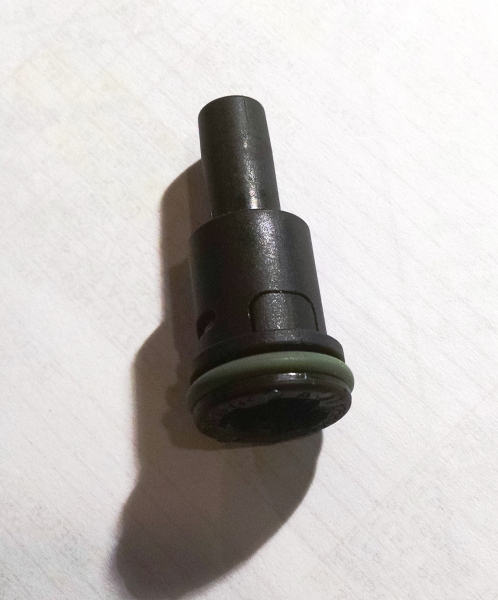
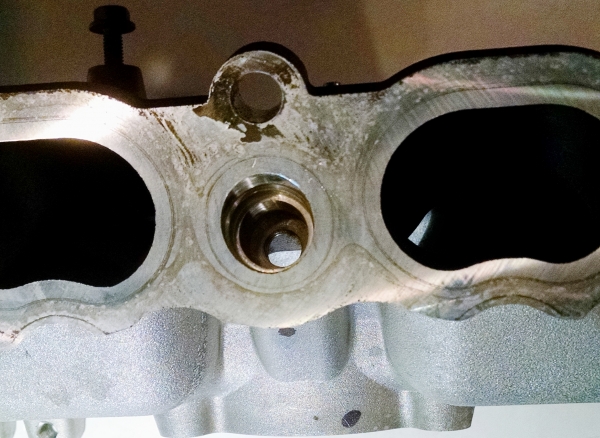
This is the one that is active when idling or under vacuum conditions.
Here is a picture of the PCV valve and the hole it's in.
This is the one that is active when idling or under vacuum conditions.
Moderator
Joined: 05-01-2014
Posts: 8,512
From: California
OK I don't think I'm understanding. The link in my post above for "blow by catch can" shows the inlet hose. The component with the check valve snaps into that near the top of the hose, just downstream from the MAF sensor. If you're saying the PVC valve is there, Then is my check valve installed backwards? Because the "flow" arrow is pointing back towards the motor.
Here is what I see. The part with the check valve is to the right. I 'unsnapped' it from the inlet hose and pulled the inlet hose back.
There is also a braided stainless steel line from the engine to the mouth of the turbo, it has a bit of green paint at the top. I would suspect oil may be in this line.

Here is what I see. The part with the check valve is to the right. I 'unsnapped' it from the inlet hose and pulled the inlet hose back.
There is also a braided stainless steel line from the engine to the mouth of the turbo, it has a bit of green paint at the top. I would suspect oil may be in this line.
Last edited by RJ_RS_SS_350; Mar 11, 2017 at 11:46 PM.
Senior Member
Joined: 09-07-2008
Posts: 1,016
From: Mebane, NC
This is getting way off topic now. We may want to start another thread dealing with the PCV/Venting system on our motors.
Moderators, if you feel this conversation needs to be moved please do so.
The line with the green paint goes down to the inlet of the turbo. The other line in your picture does indeed have a check valve in it, my thought is that check valve is there to make sure no oil mist from the crankcase is pulled/pushed into the upper end of the inlet tube feeding the turbo. What you are showing in your picture is one of the breather/PCV systems.
The other is the one I have included pictures of integrated into the intake manifold that will only draw crank case vapor/mist when the intake is in a vacuum mode, when boosting that PCV/check valve in the intake manifold will close.
So when boosting the PCV/Check valve in the intake will be closed, any crankcase pressure developed during boost can't be pushed back into the upper end of intake tube feeding the turbo because the check valve you have pictured will close as well. So with that being said when in boosted mode the only place for any developed crankcase pressure/mist to go is into the inlet of the turbo, which makes sense because that line with the green paint will be at a lower pressure maybe even a vacuum depending on the pressure drop across and/or cleanliness of the air filter in the air box.
To fully understand what's going on we need to look at pictures and arrows of everything in the 2 systems including the underneath side of the valve cover where a lot of redirecting of the crankcase air flows is being done and that would need to be done in a separate/dedicated thread.
Does that somewhat help?
Moderators, if you feel this conversation needs to be moved please do so.
The line with the green paint goes down to the inlet of the turbo. The other line in your picture does indeed have a check valve in it, my thought is that check valve is there to make sure no oil mist from the crankcase is pulled/pushed into the upper end of the inlet tube feeding the turbo. What you are showing in your picture is one of the breather/PCV systems.
The other is the one I have included pictures of integrated into the intake manifold that will only draw crank case vapor/mist when the intake is in a vacuum mode, when boosting that PCV/check valve in the intake manifold will close.
So when boosting the PCV/Check valve in the intake will be closed, any crankcase pressure developed during boost can't be pushed back into the upper end of intake tube feeding the turbo because the check valve you have pictured will close as well. So with that being said when in boosted mode the only place for any developed crankcase pressure/mist to go is into the inlet of the turbo, which makes sense because that line with the green paint will be at a lower pressure maybe even a vacuum depending on the pressure drop across and/or cleanliness of the air filter in the air box.
To fully understand what's going on we need to look at pictures and arrows of everything in the 2 systems including the underneath side of the valve cover where a lot of redirecting of the crankcase air flows is being done and that would need to be done in a separate/dedicated thread.
Does that somewhat help?
Moderator
Joined: 05-01-2014
Posts: 8,512
From: California
I have no objection to moving this to a new thread.
Yes, Dennis, Thank you! I think I get it now!
At idle, and maximum vacuum, the gases are mostly pulled into the intake manifold via the pcv valve you pictured. As the negative pressure moves toward, and into boost, the gases are diverted more into the line I pictured with the dab of green paint. Did I get it?
So at negative pressure, the oil is being burned and potentially clogging the catalytic converter. But at boost, the oil is being deposited at the mouth of the turbo, running through the turbo, potentially coating the charge piping and the intercooler, then being burned and potentially clogging the cat.
Again, thank you for your patience.
My concern was that my turbocharger was on it's way out. Now my concern has diminished greatly. I stuck a finger in the turbo inlet (with the engine off) and the turbine spun effortlessly. And the fact that it is overboosting also seems to indicate that there is no friction problem.
But the amount of oil deposited... I think I should run a compression check. And the p0234 - if it doesn't correct itself soon, I'll be looking at that wastegate solenoid.
Yes, Dennis, Thank you! I think I get it now!
At idle, and maximum vacuum, the gases are mostly pulled into the intake manifold via the pcv valve you pictured. As the negative pressure moves toward, and into boost, the gases are diverted more into the line I pictured with the dab of green paint. Did I get it?
So at negative pressure, the oil is being burned and potentially clogging the catalytic converter. But at boost, the oil is being deposited at the mouth of the turbo, running through the turbo, potentially coating the charge piping and the intercooler, then being burned and potentially clogging the cat.
Again, thank you for your patience.
My concern was that my turbocharger was on it's way out. Now my concern has diminished greatly. I stuck a finger in the turbo inlet (with the engine off) and the turbine spun effortlessly. And the fact that it is overboosting also seems to indicate that there is no friction problem.
But the amount of oil deposited... I think I should run a compression check. And the p0234 - if it doesn't correct itself soon, I'll be looking at that wastegate solenoid.
Senior Member
Joined: 09-07-2008
Posts: 1,016
From: Mebane, NC
Yes you have it. The oil does a number of things that aren't good. It can contribute to detonation and since our motors are DI it has a tendency to coke up on the back of the intake valves.
I believe your problem is the wastegate solenoid as well.
Please let us know what you find that way others can learn.
I believe your problem is the wastegate solenoid as well.
Please let us know what you find that way others can learn.